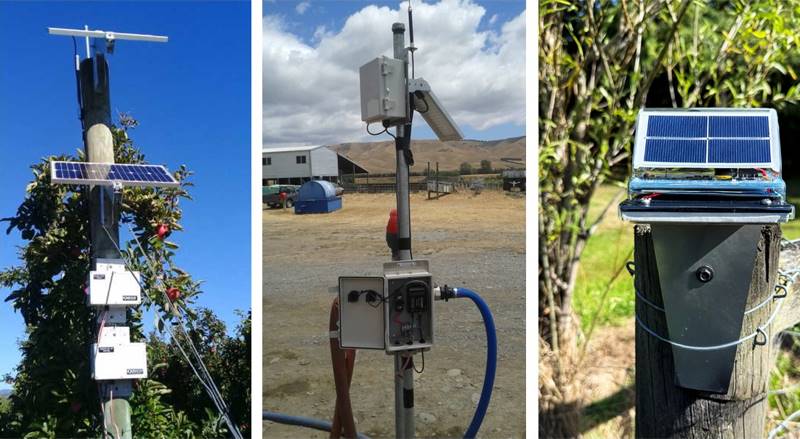
DATRAN Australia has a range of solar powered solutions available. This article provides an overview of the solutions and some example applications to help you understand when and where to use them.
We have two versions of a highly customisable solar power solution, the RSS01 and RSS02. Details are available here. We also have dedicated solid set irrigation controllers and a water tank level monitor with integral solar supplies.
4G SMS Lite – Cellular Controller
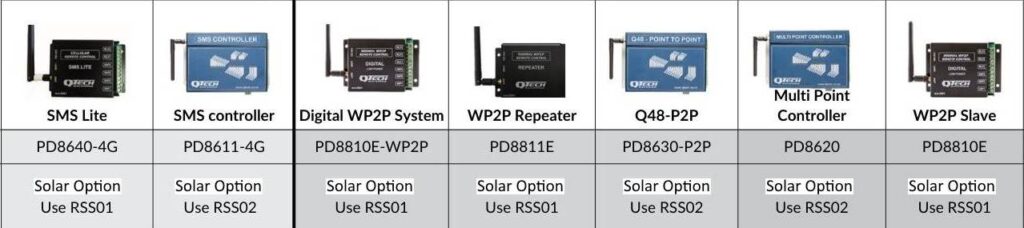
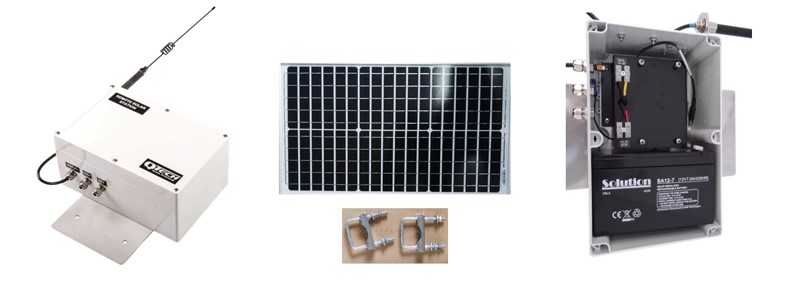
The 4G SMS Lite provides monitoring and control options via text message. It is a very popular option to be solar powered as it has a low current draw. The SMS Lite is ideally suited to our RSS01 solution which is shown below:
WP2P – Wireless Point to Point & Wireless Repeater
The popular WP2P digital I/O modules are all very low current which makes them ideal for use in solar powered solutions. The wireless repeater is used to provide a comms path between WP2P modules. Repeaters are frequently installed on hills. Inevitably, the hill site is remote and does not have a power supply. For WP2P and Repeater applications, our RSS01 solution is needed. The RSS01 includes the solar panel, back up battery, charge controller, antenna, mounting hardware in a robust environmentally protected enclosure. We can also install and prewire the WP2P Repeater in the RSS01 before dispatch. Speak to sales now for more info.
MPC – Multi Point Controller & Q48-P2P
The MPC is the central controller for radio networks of up to 8 sites. The solar supply required for this system is the RSS02. The RSS02 is a larger version than the RSS01 and is best suited for the larger current draw of the MPC and Q48-P2P systems. The MPC module and any optional latching relay modules can be installed and prewired before dispatch.
The powerful SMS Controller is a 4G monitoring and control device. The solar supply required for this system is the RSS02. This is the larger version than the RSS01 and is best suited for the larger size and current draw of these systems.
Irrigation – Fixed Grid & Solid Set Controller
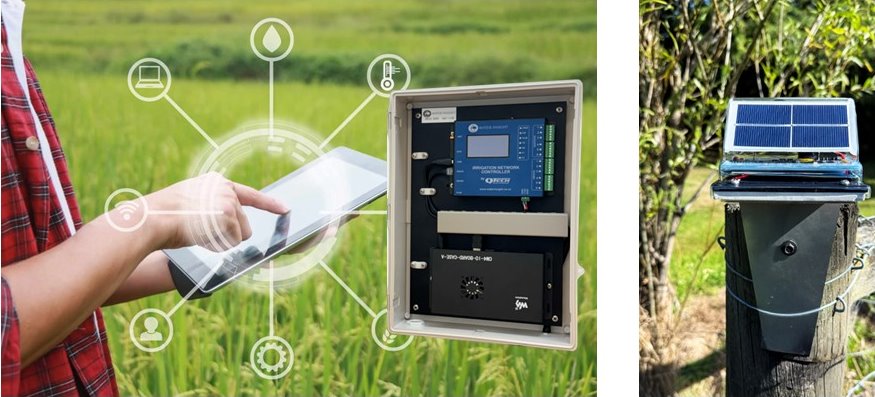
The Water-Insight IPC is our solar powered irrigation controller which operates a DC latching solenoid. The solar panel and rechargeable LiPo battery are integral to the enclosure, together with a proven BMS charging circuit. The 1500mA battery is easily replaceable and mains powered battery chargers are also available for service providers. The unique case design orientates the solar panel towards the sun for maximum charging potential without additional mounting hardware etc. Thousands of IPCs control farm irrigation throughout NZ and Tasmania and they can be scheduled and operated from your phone.
There is also a solar powered repeater for IPC systems. The solar repeater helps ensure that all IPCs on the farm can communicate back to the central hub, the IMS gateway.
Water Tank Level Monitoring
The Water-Insight TLM is a solar powered IoT device for water tank level monitoring. The TLM shows the water level and water usage on your phone but also sends alerts when things change. The TLM does not use the cellular network and does not need a SIM card. The TLM communicates via low power LoRa radio to a gateway which plugs into your modem. The TLM uses the same solar power technology and mounting hardware as the IPC repeater.
There are many ways DATRAN Australia can help with your irrigation control solutions.
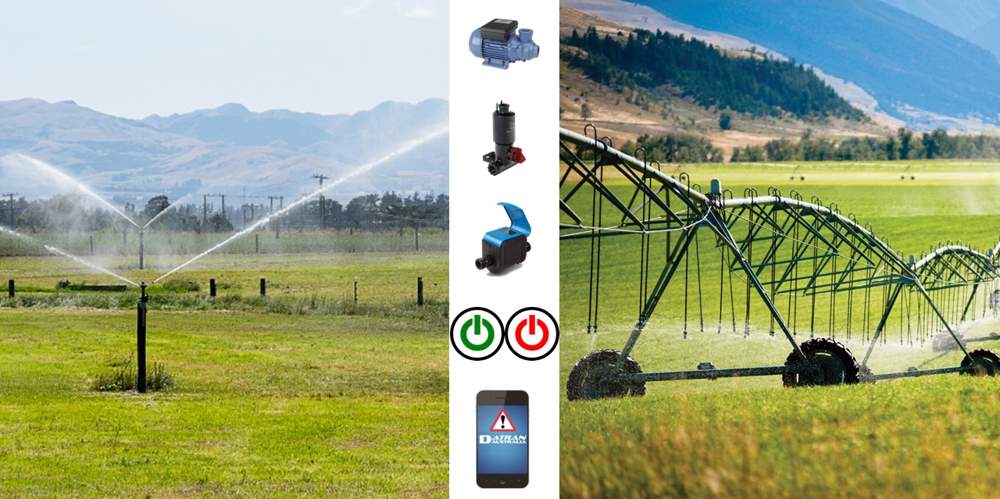
Whether you use solid set irrigation, centre pivot or other forms of irrigation our controllers can help.
Solid Set Irrigation
The IPC provides automatic schedule-based sprinkler control for solid set irrigation systems.
The Water-Insight IPC is a smart, solar powered solid set sprinkler controller that uses low power mesh radio. The IPC is installed on each fixed grid post or pod and operates a DC latching solenoid to control the irrigation. The IMS cloud technology allows you to communicate with and control IPCs from your phone. The irrigation schedule is created online and and changes are easily sent to the controllers.
Solid set (or fixed grid) irrigation is hugely popular in New Zealand and is growing in Tasmania.
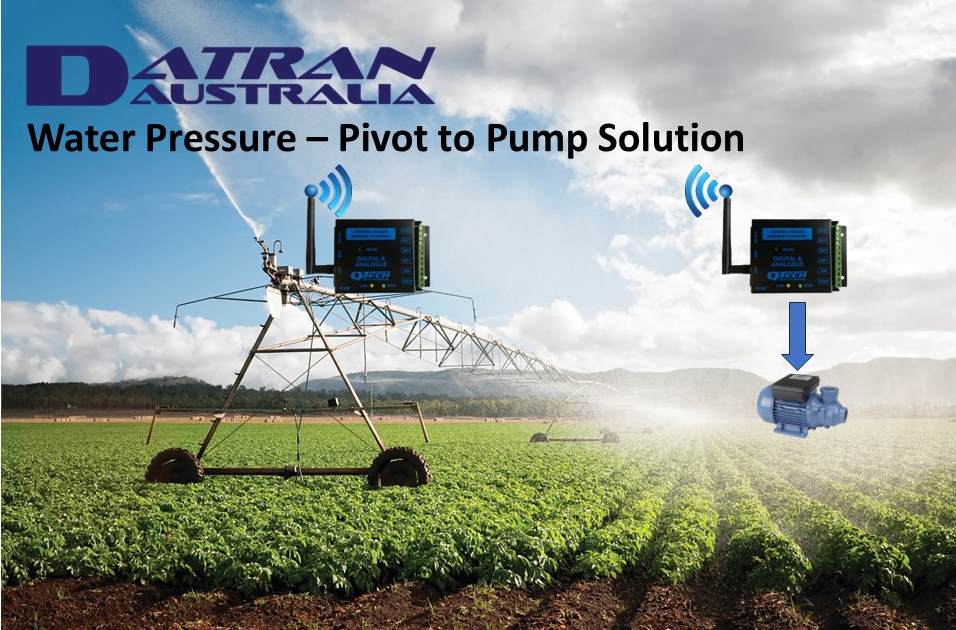
Both the WP2P and “WP2P star” systems are used to start irrigation and can even be used to communicate with other pivots or to help provide a pump interlock signal.
Remote monitoring of the flow meter. Similar to the water pressure example above, send the 4-20mA instantaneous flow reading from the flow meter using the WP2P analogue I/O system.
We also have 110V AC power packs that connect to the pivot’s power circuits and provide the 12V DC for our controllers.
Irrigation Pump Control
The most popular solution here is to remotely start and stop the irrigation water pumps from the pivot centre point. This prevents having to drive to the pump shed to manually start the pumps. The WP2P low power radio system and the 4G cellular SMS Lite are most commonly used.
Many pivot control panels do not have alarm sending options, but they do have configurable Aux output relays. Use our 4G SMS Lite to send SMS text messages when the Aux output relay operates. You can now be notified if the pivot stops or there is an alignment fault.
Other Irrigation – Orchard, Drip Line, Greenhouse etc.
This project used our MPC system with WP2P modules together with RSS01 solar supplies and latching relay modules. Other projects utilise the SMS Lite to monitor faults, provide remote control and send alarms.
Latching Solenoids Remote Control
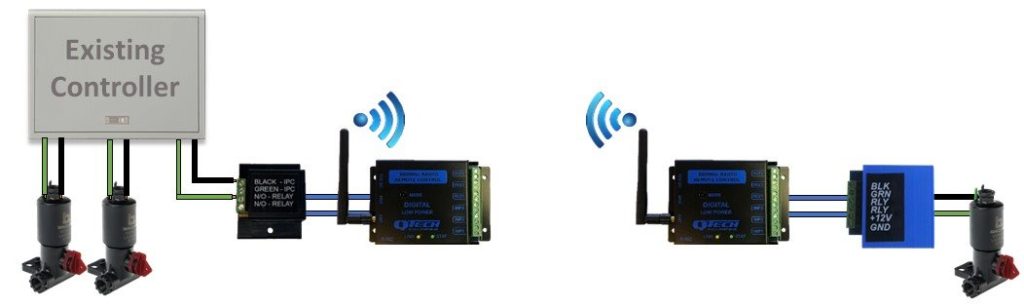
Remote control of latching irrigation solenoids over a low power radio link.
Another handy solution provides the polarity switching required for common latching irrigation solenoids, widely used in irrigation systems. We have two solenoid modules available which can be integrated into the same project.
Another great example of our Wireless Point to Point system saving time and improving safety.
A local shooting club recently approached up for help with a remote-control warning flag solution.
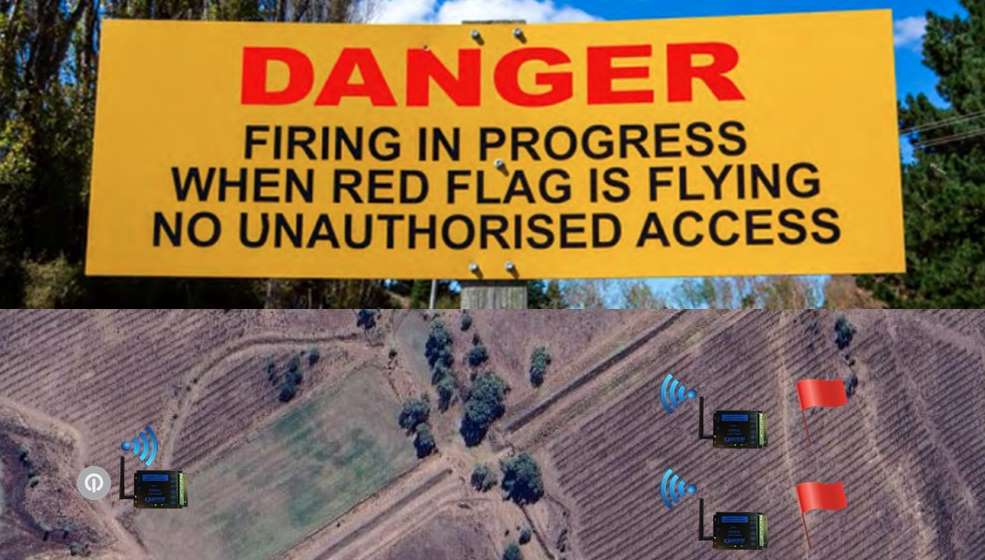
All shooting ranges have strict safety requirements that includes warning flags. This shooting club had multiple entry points so needed two warning flags and wanted to improve range officer safety by remotely controlling of the flags. The club location is rural but is also adjacent to a road and the flags need to be mounted about 320m and 420m from the club house.
A feedback signal is also needed to confirm that each flag is fully extended.
The flag actuator module and 12V DC supply were supplied by the club. A normally open limit switch was also provided, which closes on full flagpole extension. This switch is wired into a digital input of the WP2P module.
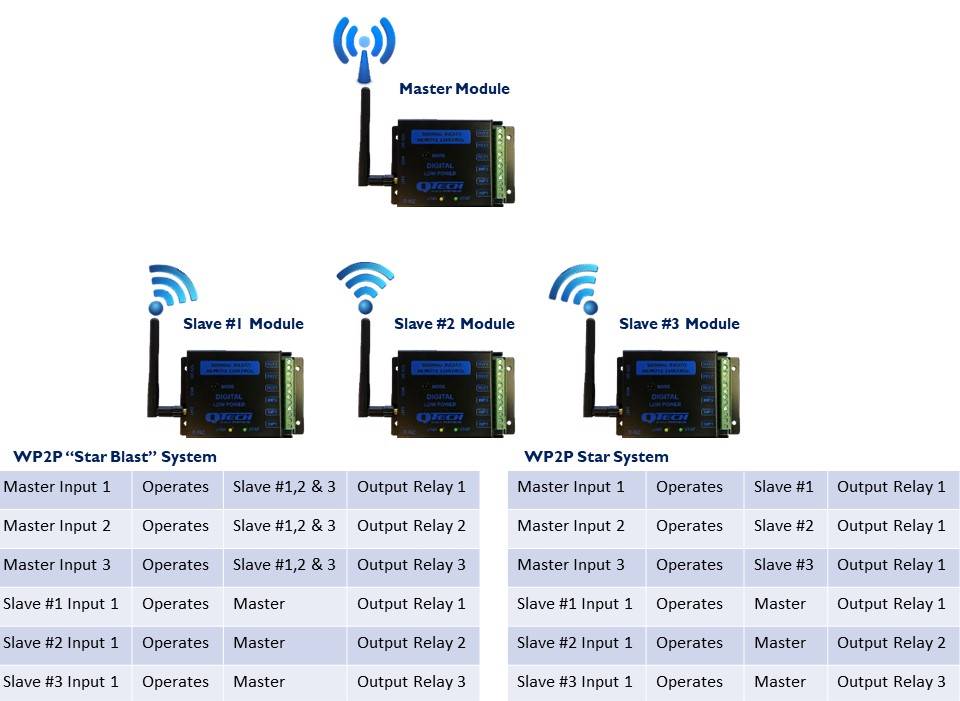
Typically, WP2P systems are supplied as a matched pair of modules. However, there are two custom options available each allowing up to four modules to be used. The I/O is then automatically mapped between the modules. These options are called “star” and “star blast” and they have different I/O mapping depending to match your project requirements.
This shooting range project is suited to the WP2P star blast option. By using the QTech WP2P star blast system, the flag operator can now safely operate the flags from the club room and a green light indicates when the flags are fully extended.
The items required for this project are:
Qty 3x WP2P Modules – Part Number PD8810E – Configured as “star blast”
Qty 2x DC power lead (for flagpole WP2P modules) – Part Number CB-QDR-PWR
Qty 1x Power supply Plug Pack – Part Number PD5412 (for the club room)
Qty 3x 900MHz Whip antennas – Part Number PD9241
The WP2P star blast option is a popular choice and gives the following automatic mapping of the I/O. This project only used 2 slave modules but can be extended to the 3 shown below.
Of course, our popular 4G SMS Lite can also perform this type of control and monitoring requirement by sending text messages. However, this was not a preferred option for this customer.
There must be a sign at the main entrance to a shooting range and any secondary or alternate access point to the range. Signage must contain the range or range complex name, contact details for the shooting club or shooting range operator.
Shooting ranges must fly a large RED warning flag to indicate that the range is in use. The flag must be of a size and condition to stand out and be visible from the access point to the range. The flag must be flown from a flagpole at a height that can be easily seen. The flag should be a minimum dimension of 600 mm x 1200 mm.
The flagpole needs to be in a prominent position, clearly visible to those approaching the range. If there is more than one entry point to the range and they are not visible to each other, then a flagpole is required at each entry point. The location and number of flagpoles depends on the design and layout of the range.
Flagpoles must not be placed in a location that poses a hazard to anyone operating the flags, e.g. not on a backstop where the flag operator would be exposed to fire from an adjacent range.
If the range is used for night firing activities, the red flag(s) are to be replaced by suitably visible red flashing lights.
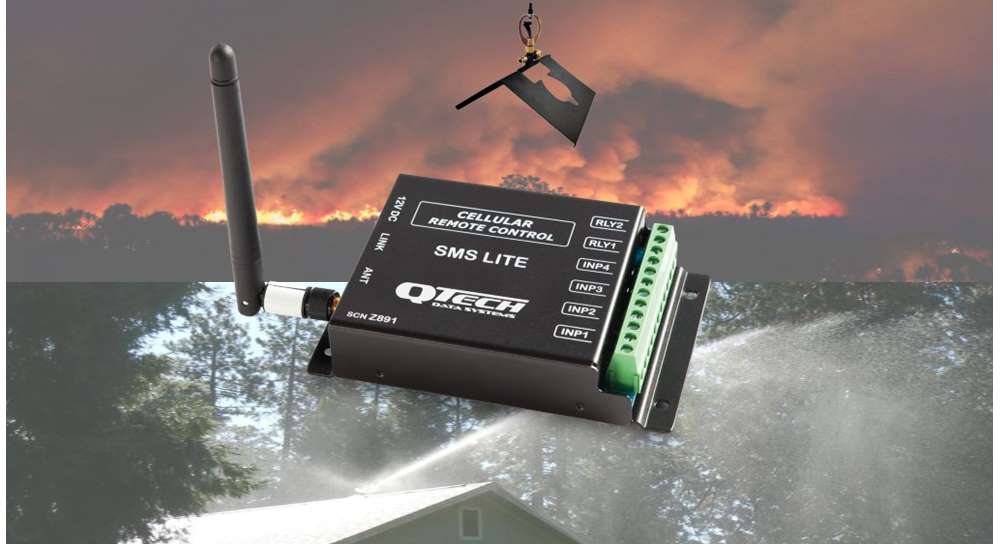
Send the SMS Lite a text message and it activates the roof sprinklers. The SMS Lite is also very low power and can easily be solar powered. Roof mounted sprinklers are very popular as a bushfire defence tool and are also used in New Zealand and the USA. The Rural Fire Service NSW website has some great resources and a very useful bushfire preparation guide.
Please check out the Rural Fire Service guide by clicking the link below. Be prepared for this bushfire season – Do not leave it too late.
If the water supply to the bushfire protection sprinklers is pumped via a generator, you may need to consider a way to switch the genset on remotely. We have possible solutions for that too. Click this previous article for more info.
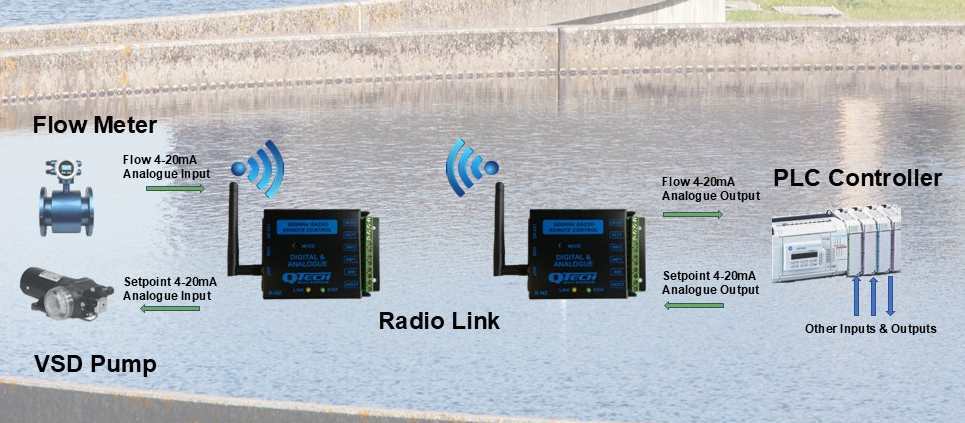
allows you to send and receive a 4-20mA analogue signal. It provides a low power radio link between the flow meter and the VSD setpoint control at a PLC.
The customer’s existing system uses a central PLC for overall site control. However, a new flow meter and pump with a VSD control was added. The application needed to integrate the new 4-20mA flow meter signal and allow the regular changing of the setpoint and speed of the pump to suit the overall water demand.
QTech WP2P solutions can provide a radio alternative to cables over a distance of up to 3km, although this project only needed to travel 1800m.
providing a cost effective way of routing around an obstruction such as a hill or a building.
Additionally the WP2P analogue also has two digital inputs and two digital output relays. These can be easily incorporated into the project for remote start, stop or fault monitoring and reset of the remote pump.
Key Features of the WP2P Analogue and Digital system include: Low power consumption No programming or configuration and easy mounting and installation Line of sight operational ranges of ~350m with the supplied antennas, ~2km with optional whip antennas, and up to 4km with Yagi antennas Link status LED provides confirmation that the two modules are communicating Isolated 0-20mA Analogue I/O and relay outputs for maximum diversity State of the art digital radio using 900MHz Digital Modulation technology All operating distances are indicative only and are terrain dependent.
We have a selection of DC power supplies including mains plug packs and even 110V AC input power packs for centre pivot irrigation solutions.
Please remember that each WP2P module requires both an antenna and a power supply.
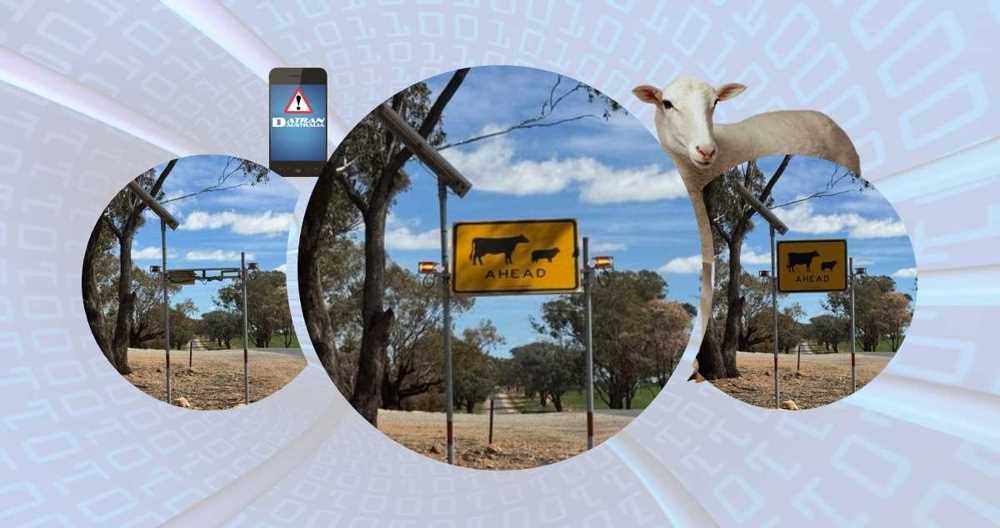
These solar powered rotating animal warning signs use the 4G SMS Lite for remote control.
When livestock is being moved, or there is a report of stray animals in the location, a text message is sent to the SMS Lite.
The text message required to control the sign is simply “ON Sign”.
When the warning sign receives the text message, the SMS Lite operates it’s relay outputs. The sign then starts to rotate and the amber warning lights start flashing. The photos show the warning sign rotating at its installed location in regional NSW.
A key requirement for our customer was to notify five people that the sign has been activated. The notification message they all receive will be “Sign has switched ON”.
The SMS Lite easily achieves this requirement as up to eight mobile numbers can be added to it’s address book.
As the warning signs are solar powered, the power consumption of the SMS Lite was also an important project consideration. With a current draw as low as 13mA, the system designer was able to easily integrate our controller within the system power budget.
The SMS Lite is easy to set up – simply by sending it a few text messages. The SMS Lite also has some powerful features like pulse outputs, supply voltage monitoring and input debounce options.
Please check out our YouTube channel for a selection of SMS Lite videos including getting started, troubleshooting and how to select power supplies.
If you need remote control of animal warning signs, sheep ahead alert systems or even flood warning signs, our 4G cellular products will help provide a solution.
Relay Contacts – The output relay contacts in the SMS Lite are low power DC contacts. They will need interface relays or contactors to operate high current and AC mains powered pumps.
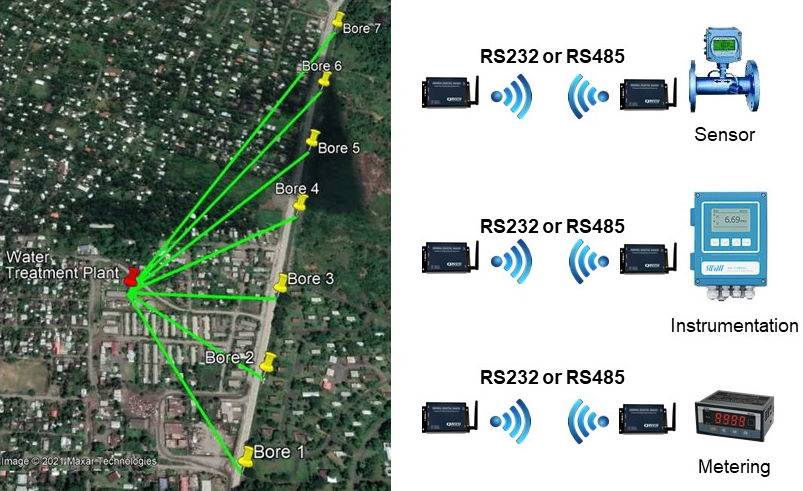
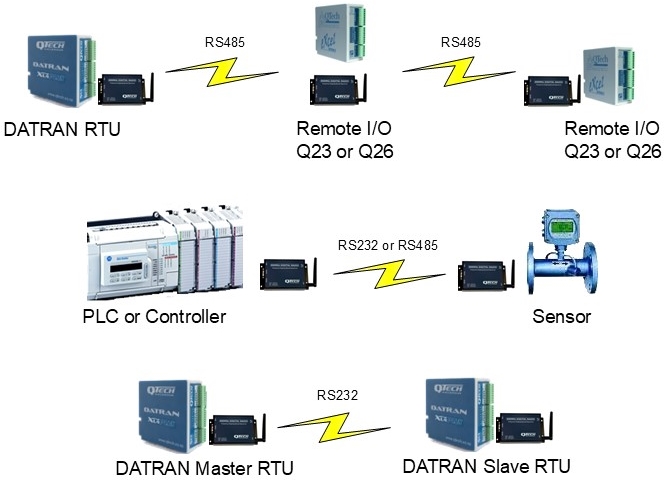
The QTech QDR are low power radios that provide wireless RS232 or RS485 serial cable replacements.
The QDRs are lower power and more cost effective than conventional radio systems. They use a sophisticated digital modulation technology, have an outstanding receiver sensitivity and can operate at up to 9600bps data rate.
The QDR radios are powered from our range of DC power supplies including plug packs and power packs.
Workbench is the software application used to configure the QDR radios via USB.
The QDRs can be configured in Point to point, point to multipoint and repeater configurations. This helps extend the system design options and increase the potential transmission range. The radios also have “radio ID” settings – these settings tie the QDR modules to a specific customer and a specific system. This helps ensure security and you can use multiple radios all in the same area.
We have a selection of high gain antennas compatible with the QDR, these give you options to increase the range to several kilometres. In the Water Treatment Plant design above, the master QDR in the control room used the 6dB whip antenna and all the bore sites used our Yagi antennas.
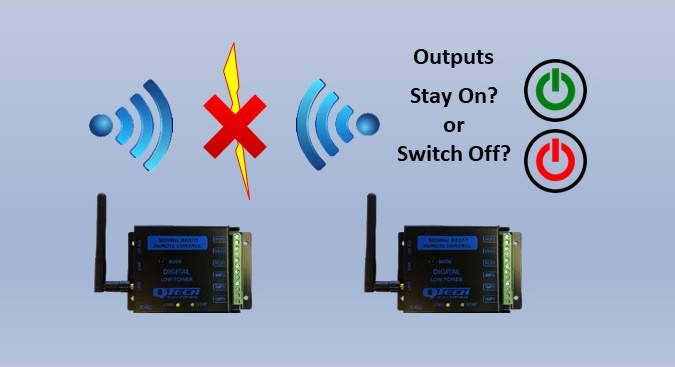
When designing your remote monitoring system, it is important to consider what happens to the output signals if the radio link goes down or is interrupted, ie “failsafe”.
Failsafe in this context means causing a piece of equipment to revert to a safe condition in the event of a malfunction or breakdown. A good example is effluent pump control – Do you want the connected pump to continue pumping or is it better to switch the pump off for the duration of the comms fail?
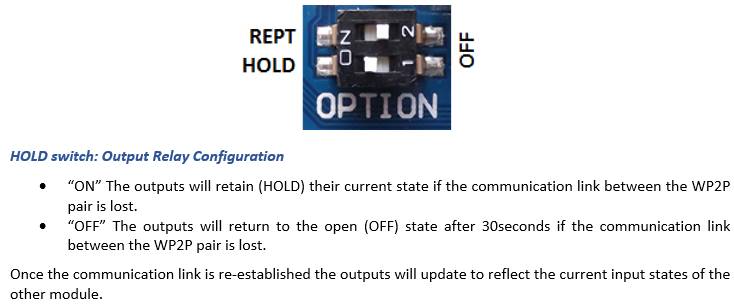
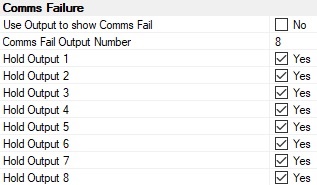
Our WP2P, MPC and Q48-P2P systems all give you failsafe options if the radio comms link is interrupted, ensuring that the consequences are minimised.
The Q48-P2P system controls the state of the outputs if the radio link is interrupted, ie comms failure. Normally, if a comms fail happens the modules retain their last known state (eg if an output is on, it will remain on during a comms fail). However, this does not suit some applications.
A factory configuration option is available for Q48 P2P systems. It is called “failsafe” which must be requested when you order a Q48-P2P system.
Using the failsafe feature, the digital outputs will all switch off for the duration of the comms fail. Similarly, the analogue output signals will go to 0mA.
on both failsafe and how long a comms failure will take to establish.
Note – The Q48-P2P failsafe feature is subtly different to the WP2P and MPC systems. Please be mindful of this if you are already familiar with our WP2P systems.